Masonry work across older central Ohio properties demands specific machinery matched to structural density. In historic districts like German Village and Victorian Village, foundation updates often require wet-cut…
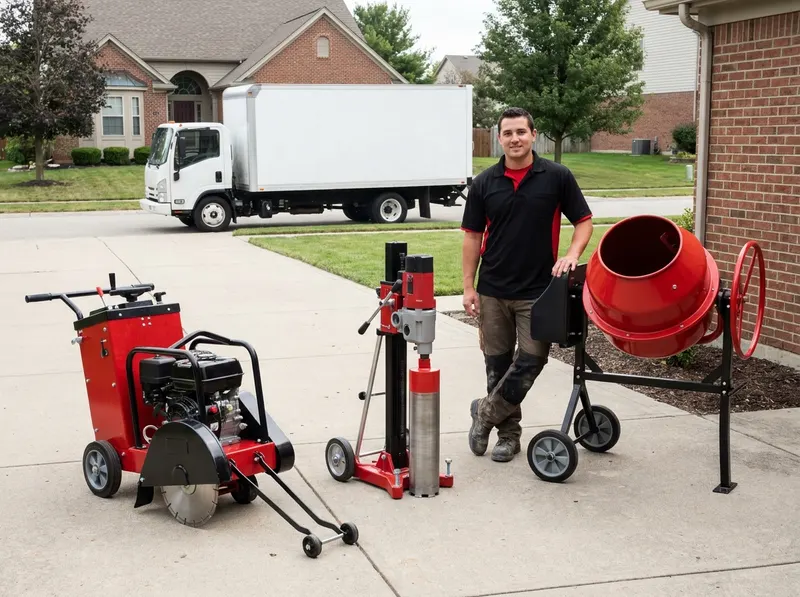
Masonry work across older central Ohio properties demands specific machinery matched to structural density. In historic districts like German Village and Victorian Village, foundation updates often require wet-cut electric or hydraulic saws to slice through thick brick and fieldstone without kicking up hazardous silica dust inside confined basements. Handheld 14-inch cut-off saws manage expansion joint cuts and doorway openings up to 5 inches deep, whereas slab-cutting walk-behind saws fit exterior trenching across wide driveways in Upper Arlington and Bexley. For plumbing rough-ins and electrical conduit passages, stand-mounted core drill rigs anchor securely using mechanical anchors or continuous vacuum bases, boring clean 1-inch to 8-inch penetrations through poured foundation walls without transferring heavy vibration to adjacent masonry.
Selecting the correct mixing apparatus depends directly on batch frequency and aggregate volume. A 6-cubic-foot electric poly-drum mixer supports bricklaying mortars and small footing pours on tight residential parcels in Clintonville or Grandview Heights, operating on standard 120-volt, 20-amp residential circuits. Larger sidewalk reconstructions or commercial slab sections throughout Franklinton and the Short North Arts District require 9-cubic-foot towable gas mixers powered by 8-to-11 horsepower engines, which produce high-slump batches using coarse limestone aggregates. The trade-off between gas and electric mixing centers on ventilation and mobility: gas units offer continuous output on undeveloped lots but cannot run indoors, while electric mixers run safely inside enclosed basements but require dedicated extension cords under 50 feet to avoid voltage drops that overheat motors.
Equipment logistics require clear access for safe unloading. Standard towable mixers require a 2-inch ball hitch and level ground clearances, while trailer-delivered saw and core drill kits need stable, flat drop points on concrete drives or stabilized road shoulders. In dense urban sectors like Linden and the Hilltop, narrow street parking or alley access can complicate drop-offs, making advance staging planning essential. Deliveries to locations near busy public corridors such as the Scioto Mile Promenade or around the Ohio State University Campus must account for local traffic patterns and pedestrian walkways. Transparent rental periods run on 24-hour daily cycles, weekend tiers, or 28-day monthly windows, ensuring active masonry restoration projects remain on schedule without unbudgeted delays.
Every job gets a firm, written price after a free on-site visit.
Tell us about your concrete cutting, core drilling, and mixing equipment rentals job in Columbus and we'll send a clear, written quote, usually the same day.
 Complete Dumpster Rental